Digital Transformation Strategy

We would like to introduce our Digital Transformation strategy.
About Digital Transformation Strategy
With the rapid progress of digitalization in recent years, the use of AI and Internet of Things (IoT) has become widespread, and it is expected that it will continue to have a major impact on society and industry, and that the speed of change will continue to accelerate. In this environment, the Kurita Group is working on Digital Transformation , aiming to create a business model that uses the power of digital to simultaneously generate economic value and social value, improve customer intimacy by change business processes, and strengthen its ability to respond to changes in the business Environment .
Kurita Group's Digital Transformation
The Kurita Group's Digital Transformation initiatives are being promoted from two perspectives: Business Transformation (BX) for customers and Operational Transformation (OX) for the company.
For Customers
Business Transformation : for short BX
Initiatives to strengthen value creation capabilities
We identify potential issues from data on facility operation status, water quality, etc., and contribute to increasing the value you provide. We aim not only to add digital elements to existing businesses, but also to create new businesses using digital as a starting point.
For Internal use
Operational Transformation
: for short OX
Initiatives to Strengthen Organizational Strength
By analyzing and visualizing a variety of data, such as business performance, customer contact information, and work information, we aim to clearly indicate potential issues in management, administration, and policy implementation, as well as to lead to the realization of diverse working styles while maintaining high employee motivation.
The relationship between management plan and Digital Transformation strategy
Kurita's Digital Transformation utilizes customer data collected by sales staff and a data infrastructure that accumulates the company's unique "water knowledge," and promotes BX and OX, aiming to realize shared value in management strategies such as "solving water resources issues," "realizing a decarbonized society," and "building a circular economy and society."
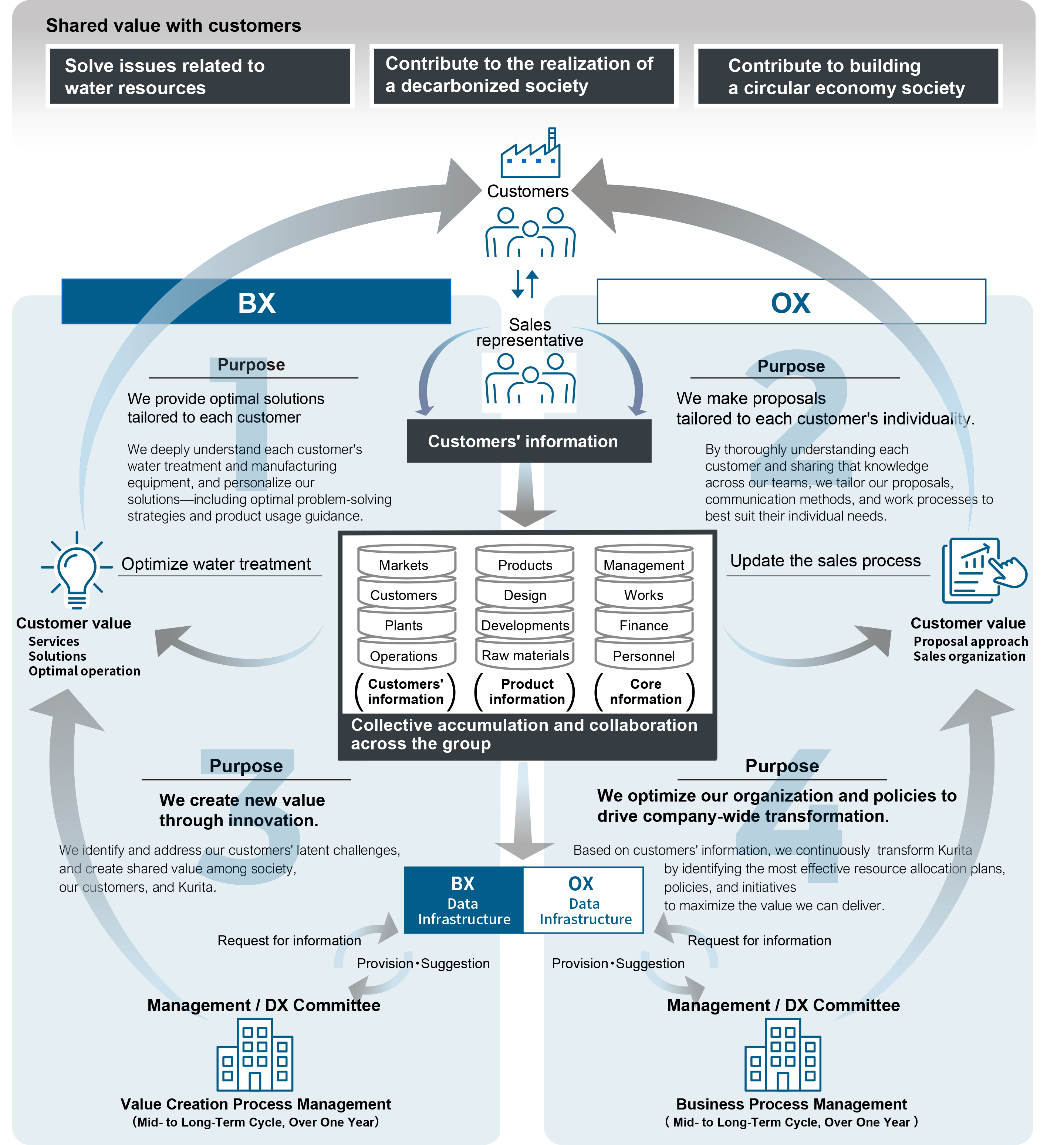
*Customer information will be handled in accordance with our privacy policy .
Digital Transformation Strategy Roadmap
At Kurita, we have developed a roadmap that outlines the phased efforts for both BX and OX to achieve the goals of medium-term management plan .
BX aims to contribute to achieving the goals of medium-term management plan by promoting the creation of new digital-driven businesses and the expansion of existing services, including the use of AI Technology and the expansion of data on its global data integration platform.
OX aims to contribute to achieving the goals of its medium-term management plan by promoting the use of digital technology to improve the accuracy and speed of management decisions, as well as the standardization and efficiency of operations, through the global expansion of data- Human Resources for Digital Technology management and the expansion of the skill areas of medium-term management plan development.

About BX OX's achievements
BX
Production Lead Time
water supply
Remote Management Service
Digital Touchpoints with customers
- S.sensing WEB
- KC360
- Data Integration Platform
OX
Human Resources for Digital Technology development
Data-driven management
- ERP and peripheral system updates
- Integrated master development
Digital Transformation Strategy Promotion System
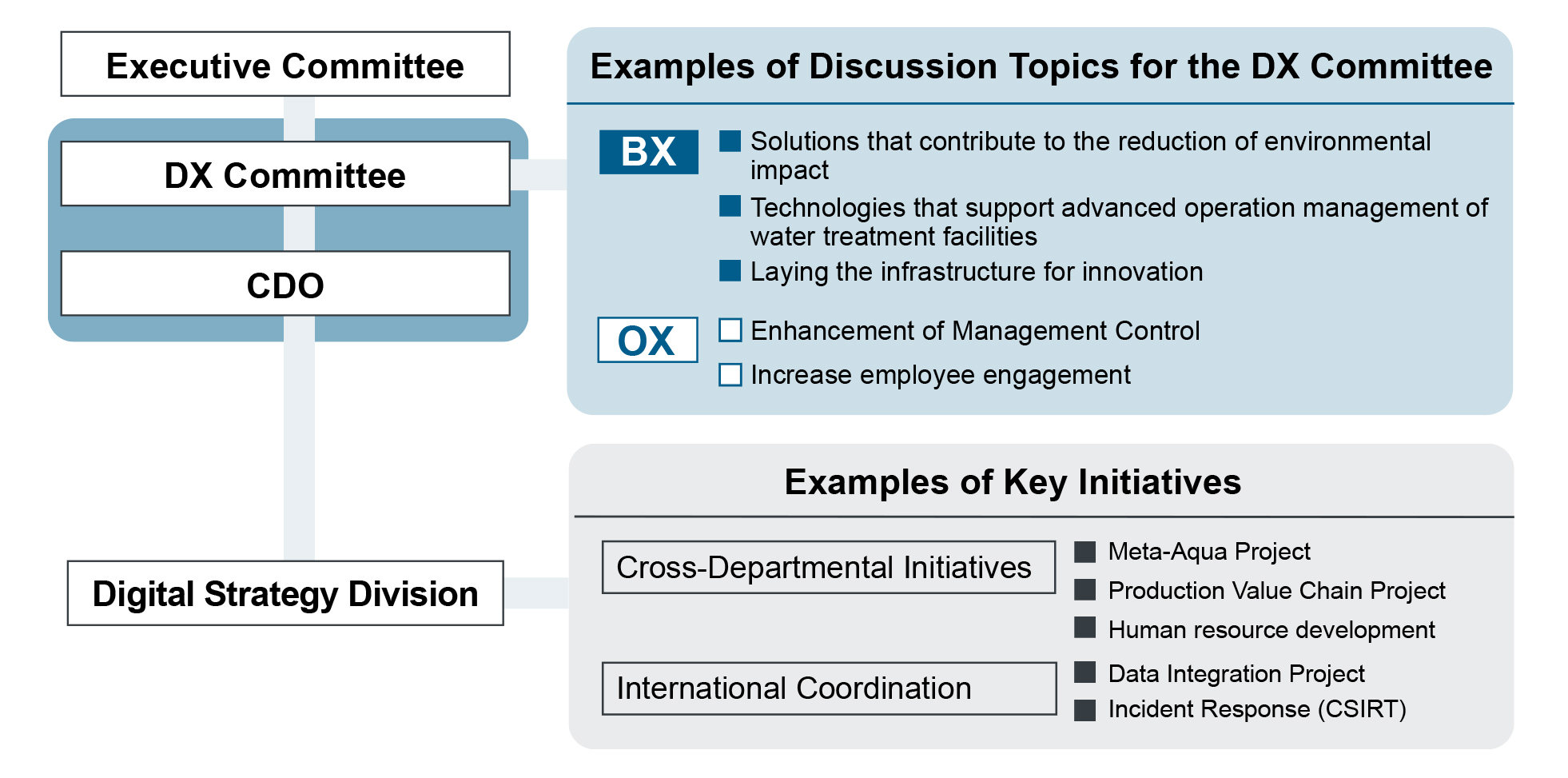
The Digital Strategy Headquarters and the CDO will take into account the impact (risks and opportunities) on the company of changes in society and the competitive Environment due to the evolution of data utilization and digital technologies , and will work with relevant departments to develop plans for the development of systems necessary to promote Digital Transformation in terms of management policies and plans ( medium-term management plan, integrated Report, etc.), transformation of business models, change of business processes, and development of new core Technology and businesses.
Utilization and Development of Human Resources for Digital Technology
Promoting Digital Transformation requires personnel who can plan and implement Digital Transformation-based strategies, develop business models, build infrastructure, and provide IT services.
At Kurita, we have clearly defined digital specialists and classified them into three types, based on the Digital Skills Standard (DSS)*.
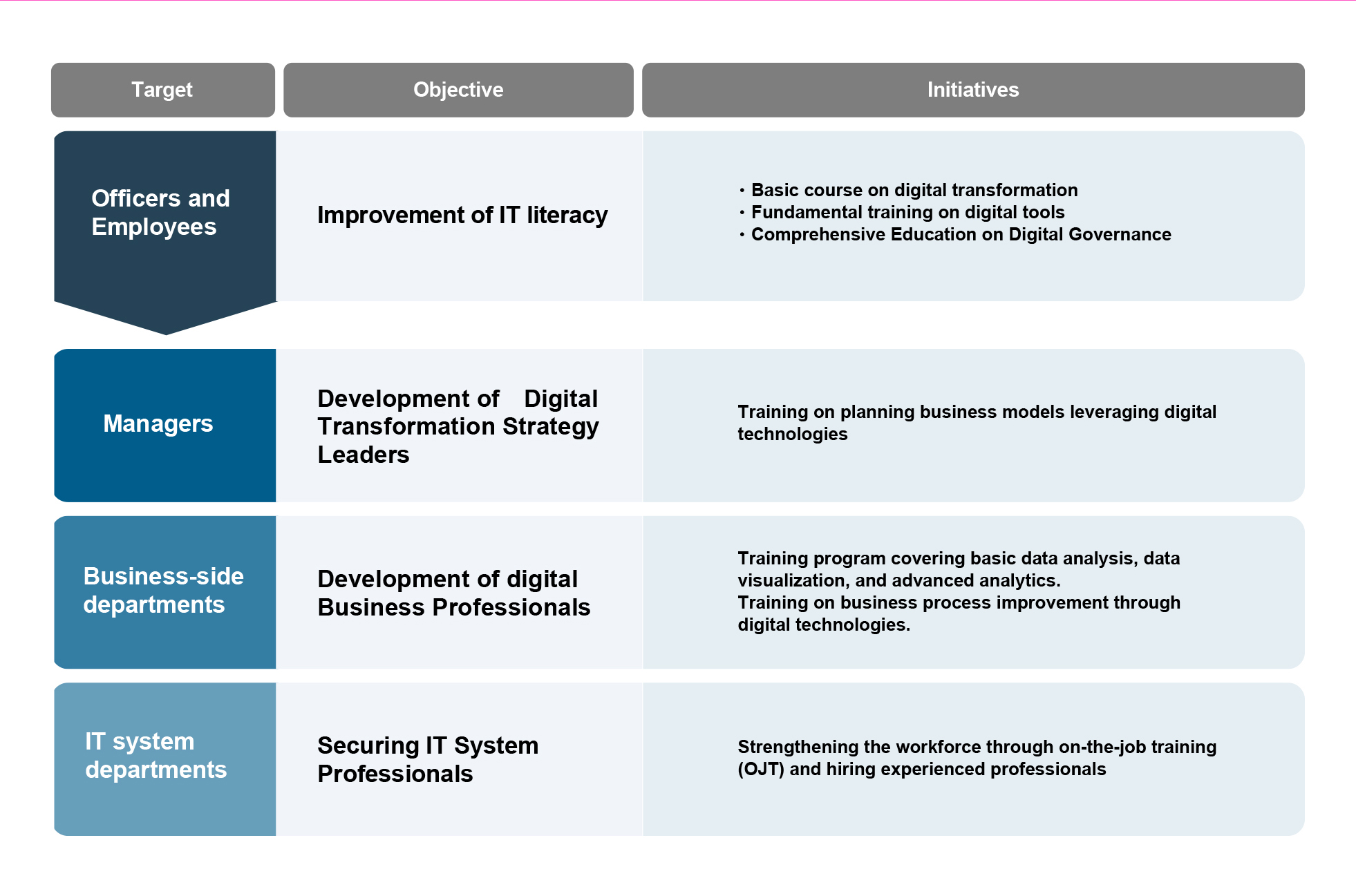
In developing human resources for Digital Technology, in addition to efforts to improve the IT literacy of executives and employees, we offer a specialized training program (Digital Transformation Master College) to applicants from domestic and overseas group companies and to personnel selected based on organizational needs. Participants actively apply the skills they have acquired in their work, and for cases where their results are recognized as having made a significant contribution to the business, we provide opportunities for them to make internal presentations and recognize their achievements through an awards system. Furthermore, in securing digital specialists, we are not limited to within the group, but are actively collaborating with start-up companies and hiring experienced personnel from outside the company.
As of the fiscal year ending March 2024, we have approximately 260 human resources for Digital Technology on staff, and we aim to expand this to approximately 750 by the fiscal year ending March 2028.
Furthermore, in order to support the independent career development of human resources for Digital Technology, we are not only providing learning opportunities but also focusing on improving personnel system and employee benefits.
* Guidelines formulated by the Ministry of Economy, Trade and Industry and the Information-technology Promotion Agency (IPA) for individual learning and corporate human resource acquisition and development necessary for promoting Digital Transformation strategies.
Kurita's definition of Human Resources for Digital Technology
People who are familiar with Kurita's business and can use their digital skills to translate their "water knowledge" into greater value.
Types of Human Resources for Digital Technology

Introduction to initiatives
Personnel system and Benefits related to Human Resources for Digital Technology
Information Security Control
Information security control is a basic practice for the Kurita Group, which uses digital technologies for the transformation of its business models and business processes. In addition to the development, maintenance, and operation of risk systems, the Kurita Group has defined "Kurita Group Information Security Policy"—along with its associated principles, standards, and guidelines—as the framework for managing information security necessary for driving DX initiatives. The Kurita Group also engages in the global implementation of security measures to prevent security accidents and minimize the opportunity loss caused by security accidents.
Daily PDCA activities
The Kurita Group evaluates its IT risks periodically, implements measures with the security assurance organization established and a budget secured, and has established the reporting system used in the event of a security accident. The Kurita Group periodically provides information security training for its employees to raise awareness of information security and reduce security risks. In addition to these efforts, the Kurita Group has established a global, multi-language, round-the-clock security monitoring system. The Kurita Group also works to improve the security of the OT (Operational Technology) environment, which is used for monitoring and controlling water treatment facility, etc. of the Kurita Group.
Organizing and Operating CSIRT (Computer Security Incident Response Team)*
Although the Kurita Group endeavors to prevent security accidents, it considers that it is impossible to implement perfect measures. Thus, the Kurita Group has organized CSIRT, an organization for taking prompt and appropriate actions in the event of a security accident as well as enhancing the organization's capability to respond and recover. CSIRT is considered to pertain to business continuity, so it is positioned as a part of BCM system. CSIRT consists of a wide range of members including those from departments in charge of information security, as well as public relations, sales, management planning, accounting, legal affairs, and operating divisions. In the event of a security incident, we will investigate the cause and implement appropriate measures. In addition, depending on the situation, we promote prompt and accurate responses, including disclosing information to stakeholders such as customers. This organization prepares an operation manual that describes ramifications of security accidents and actions to be taken for them. In addition to conducting regular training, it is a member of the Nippon CSIRT Association and strives to strengthen its initiatives by broadly gathering information.
*CSIRT is an umbrella term for organizations that respond to incidents related to computer security.
Kurita Group | Policies & Terms | Terms of use | Kurita Group Information Security Policy